
FREE RESOURCE DOWNLOAD
In 1300, London Solved this problem. Social care is solving it now.
You are buying AI you cannot fully assess. The supplier knows far more than you do about how it actually works. And from the outside, responsible AI and irresponsible AI are very hard to tell apart.
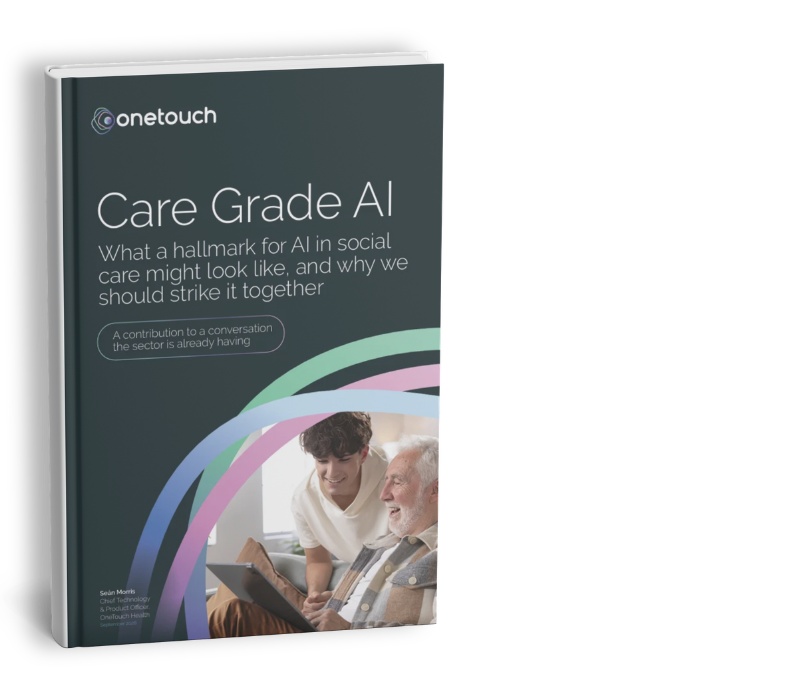
This paper proposes a shared quality standard, a Care Grade hallmark, for what AI in social care might look like. And it argues that no single supplier, including us, gets to award it.

The problem
You are looking at two AI systems.
From the outside, you cannot tell which is which.
Both have polished interfaces. Both have demonstrated on clean data. Both companies have confident people and well-designed websites.
One of them grounds everything it produces to source information, flags uncertainty, and requires a human to review before anything enters a care record. The other produces fluent, confident notes that are occasionally wrong in ways a busy coordinator will not catch until something has gone wrong.
Ecomonists have a dry term for this: information asymmetry. The care sector understands it perfectly well without the vocabulary. When you cannot assess what you are buying, and the cost of being wrong is measured in harm rather than inconvenience, the market fills up with claims that cost nothing to make and everything to trust.
The problem is not new. It is seven hundred years old. And the people who solved it were not regulators. They were a company of makers who agreed that their whole trade was better served by a shared standard than by each of them vouching for their own work.
Care Grade AI is not a badge OneTouch is awarding itself.
It is a name for the standard the sector is already working towards. The Oxford collaboration on responsible AI in adult social care, the regulators across England, Ireland and Australia, NICE's Evidence Standards Framework, ISO/IEC 42001 for independent AI governance audit, the work is well under way. What has been missing is a shorthand: something specific enough that a registered manager, a commissioner, or a family member can put a question to any AI system and know what a good answer looks like.
This paper is a contribution to that conversation, from one technology supplier who wants to be a useful part of it. The seven questions it proposes are not OneTouch's. They are the questions we would want answered as a buyer, and the ones we expect to be asked of us as a supplier.

Why care is different
Care often crosses borders
A single provider may operate in England, Wales, Ireland, and Australia at once, answering to different regulators and different data protection regimes. Any shared standard has to be written with that complexity in mind, not as an edge case.
The harm can be slow and invisible
A system that nudges documentation towards what a model expects, or that allocated slightly less support to some people rather than others, does its damage gradually, across thousands of small interactions that no single person is positioned to notice. That kind of harm does not show up in a demo.
The harm can be slow and invisible
The subject of a care record may be living with dementia, may have no one checking their notes, and may never know that software shaped the support they received. The same is true of care workers whose rotas and workloads are increasingly shaped by the same systems.
The assistance-or-decision line changes everything
The most important boundary in care AI is between a system that helps a person record or find information and a system that decided what should happen. Where that line falls changes the risk, the regulatory category, and the kind of oversight required. It needs to be drawn deliberately, feature by feature.
Seven questions worth asking
A hallmark was never a single stamp. It was a set of marks strucktogether, each answeringa question a buyer cared about.
These seven questions are a practitioner's attempt to turn good principles into something that can be asked on a busy day. They are not a certification scheme and they are not OneTouch's. They are questions we would want answered as a buyer, and the ones we expect to be asked of us as a supplier.
The detail of what a good answer looks like, and where the honest answer is still "not yet", is in the paper.
Where does the data go?
Not just stored, but also processed. By which AI models, in which countries, and whether any of it is used to train or improve those models. The answer should be demonstrable in how the system is built, not only promised in a contract.
Is every output anchored to a record?
Large language models can produce fluent, confident text that is simply wrong. In a care record, that is not an inconvenience — it is an inaccurate clinical document. It is fair to ask how a system ties what it writes to real source information, and how a person reviews and confirms its work before anything becomes part of the record.
Is it helping or deciding?
For each feature: does it assist a person, or does it make a decision? Where a feature could influence a clinical or medication decision, what safeguards surround it, and has it been assessed against medical device rules? The honest answer will differ from feature to feature, and that is fine. What matters is that someone has thought about it on purpose.
Can a person understand it, and genuinely say no?
Human oversight only means something if the person has the information and the authority to overrule the system. A coordinator should be able to see why a schedule was proposed and change it without friction. A manager should be able to challenge a risk flag with a reason in front of them. And when an inspector asks what happened, there should be a trail.
Has it been tested for fairness, for everyone it touches?
AI learns from historical patterns, and historical patterns in care are not always fair. It is reasonable to ask whether a system has been tested for uneven effects before it is used, how it is monitored afterwards, and what happens when a problem is found. That question applies to the people who draw on care, and equally to the care workers whose rotas and workloads are shaped by the same software.
What happens when the model changes?
The models underneath many AI features are updated by their developers on their own timetable, and an update can change how every feature built on them behaves. It is fair to expect notice of significant changes, testing before an updated model reaches live care records, a way back if quality falls, and a plan if a model provider withdraws or changes its service.
Would the person know?
If an assessment conversation is recorded and transcribed, or a care note is summarised by software, the person and those who support them should know, should understand what it means for them, and should have a real choice where consent is required. This is not just good practice. The Oxford collaboration's work on responsible use is explicit about it.
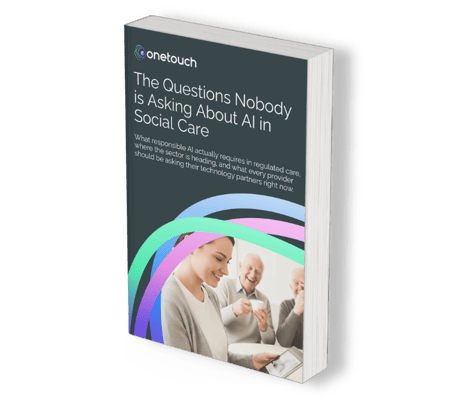
Missed the first whitepaper?
The first paper in this series, The Questions Nobody is Asking About AI in Social Care, covers the regulatory landscape facing providers now: the EU AI Act compliance deadline, what the ICO actually requires of human oversight, hallucination risk in care documentation, and the seven questions to ask any technology partner before you sign.
If you're new to the series, it's the place to start.
About the author
Seán leads technology, product, and AI strategy at OneTouch Health, a multi-jurisdiction SaaS provider operating across the UK, Ireland, and Australia. His work spans community care, adult and children's care, eLearning, and regulatory compliance platforms.
Before OneTouch, Seán spent 14 years as SVP at Fidelity Investments and has held senior leadership roles in cybersecurity technology, including at TitanHQ. He holds eight US patents in AI and cybersecurity, and is a former Chair of the ITAG Cybersecurity Forum.
This paper is not a position OneTouchis staking out. It is a contribution to work the sector is already doing, from one supplier who wants to be held to the same standardas anyone else.
Want to talk through what this means for your organisation?
Seán speaks regularly with Registered Managers, Operations Directors and care group leaders about AI governance — what it actually requires, what the regulatory changes mean in practice, and what questions to put to the technology you're already using. No sales pitch. A practical conversation.